Francis Barraud, a name perhaps less familiar than the iconic image inextricably linked to it, stands as a fascinating figure in the history of art and popular culture. Though not a musician himself, Barraud's artistic creation, "His Master's Voice," inadvertently became one of the most recognizable and enduring trademarks in the history of the recording industry. This biography delves into Barraud's life, artistic background, the creation of his masterpiece, and its profound and lasting impact on the world of music and beyond. It examines not only the painting itself but also the context of its creation, the artistic trends of the time, and the evolving perception of art's role in shaping commercial and cultural landscapes. 1900-1909 Historically, they are inseparable from the identity of the 1900-1909 Music Era.
Early Life and Artistic Beginnings
Francis Barraud was born in Liverpool, England, in 1856, into a family with a strong artistic inclination. His father, Henry Barraud, was a successful painter known for his depictions of animals, a theme that would later resonate in Francis's most famous work. Growing up in an artistic environment, Francis naturally gravitated towards painting, receiving formal training and developing his skills in portraiture and genre scenes. While details of his early artistic career are somewhat scarce, it's clear that he was a competent and dedicated artist working within the established conventions of late Victorian art. He exhibited his works, showcasing a range of subjects, demonstrating a solid foundation in the academic tradition of painting.
The Genesis of 'His Master's Voice'
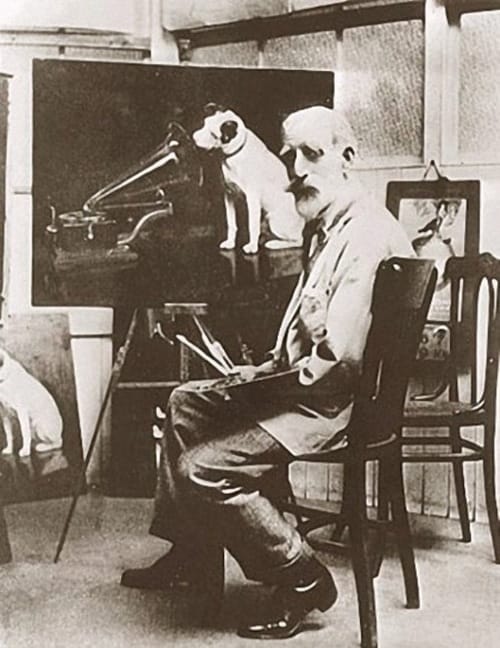
The story of "His Master's Voice" begins with Nipper, a mixed-breed dog belonging to Francis's brother, Mark Barraud. Nipper had originally belonged to their deceased brother, Philip, and the dog displayed a unique curiosity towards the sound emanating from a phonograph. Mark, recognizing the peculiar scene, had captured the moment in a photograph. After Mark's death in 1887, Nipper came to live with Francis. In 1898, Francis, inspired by the photograph, decided to recreate the scene in paint. Initially, he used a cylindrical phonograph. However, he was dissatisfied with the aesthetic. He felt a disc machine, with its more elegant and modern design, would enhance the composition. He wrote to the Edison Bell Company, offering to include one of their machines in the painting, but they declined. Undeterred, Barraud replaced the cylindrical phonograph with a Gramophone. The Gramophone Company subsequently acquired the painting and adopted it as its trademark, launching it into global recognition.
The 'Look': Fashion & Aesthetics Deep Dive
While Francis Barraud wasn't a figure known for setting fashion trends, understanding the aesthetic context of his time is crucial to appreciating "His Master's Voice." As a painter in the late Victorian and early Edwardian eras, Barraud's personal attire likely reflected the practical sensibilities of the time. Artists often favored comfortable, functional clothing that allowed for ease of movement while working. Think tweed jackets, sturdy trousers, and perhaps a simple collarless shirt. The emphasis was on practicality rather than ostentatious display. The painting itself, however, offers a glimpse into the aesthetics of domestic interiors during that period. The warm lighting, the somewhat cluttered but comfortable room, and the focus on domestic technology (the Gramophone) all contribute to a sense of middle-class aspiration and modernity. The painting captures a moment of quiet intimacy, where technology and emotion intersect. The dark, polished wood of the gramophone cabinet, the subtle textures of the rug and the dog's fur, all speak to a carefully considered visual aesthetic that resonated with the sensibilities of the time. The focus on realism, a hallmark of Victorian art, is evident in Barraud's meticulous rendering of details, from the brass horn of the gramophone to the inquisitive expression on Nipper's face. It's an aesthetic of warmth, familiarity, and a quiet appreciation for the burgeoning technological advancements that were transforming everyday life.
Engineering & Sound Production Analysis
Although Francis Barraud was not an engineer, "His Master's Voice" inadvertently became a visual representation of the burgeoning sound reproduction technology of the late 19th and early 20th centuries. The painting's success hinges on its portrayal of the Gramophone, a revolutionary device that transformed how people consumed music. The Gramophone, invented by Emile Berliner, utilized disc records rather than the cylinders of earlier phonographs. This innovation allowed for mass production and greater sound fidelity. In the painting, Barraud skillfully depicts the Gramophone, emphasizing its brass horn, which served as an acoustic amplifier, projecting the sound produced by the vibrating needle tracing the grooves of the record. The emotional impact of the painting relies on the perceived connection between the sound emanating from the Gramophone and Nipper's attentive pose. It suggests a faithful reproduction of sound, a voice from beyond, captured and replayed through this technological marvel. While the actual sound quality of early Gramophones was rudimentary compared to modern standards, Barraud's painting successfully conveyed the sense of wonder and emotional connection that this new technology offered. The painting also highlighted the importance of acoustic engineering in the early days of sound reproduction. The shape and size of the horn, the materials used in the diaphragm, and the precision of the mechanical components all played a crucial role in the quality of the reproduced sound. "His Master's Voice" became a potent symbol of this technological achievement, even if Barraud himself was not directly involved in the engineering aspects.
Cultural Impact & Legacy
The cultural impact of "His Master's Voice" extends far beyond its initial function as an advertising image. It became a global symbol of recorded music, representing the power of technology to preserve and transmit sound across time and space. The image resonated deeply with audiences, tapping into a universal human desire to connect with loved ones and cherish memories. Nipper, the loyal dog, became an instantly recognizable icon, embodying fidelity, remembrance, and the emotional power of music. The Gramophone Company, later known as HMV (His Master's Voice), leveraged the painting's emotional appeal to build a powerful brand identity. The image appeared on record labels, advertising posters, and storefronts, becoming synonymous with quality and innovation in the recording industry. "His Master's Voice" also influenced popular culture, inspiring countless parodies, homages, and adaptations. It became a visual shorthand for music, technology, and the power of sound to evoke emotions. Even today, the image retains its cultural resonance, reminding us of the transformative impact of recorded music on society.
Critical Reception (Then vs Now)
The initial critical reception of "His Master's Voice" was primarily focused on its commercial viability and its effectiveness as an advertising image. While it might not have been lauded as high art in the traditional sense, it was widely recognized for its sentimental appeal and its ability to capture the public's imagination. The Gramophone Company undoubtedly saw its potential immediately, investing in its widespread dissemination. Some critics may have dismissed it as mere commercial art, lacking the artistic depth and complexity of more "serious" works. However, the painting's enduring popularity speaks volumes about its cultural significance. In contemporary art historical discourse, "His Master's Voice" is viewed through a more nuanced lens. It's recognized as a significant artifact of popular culture, reflecting the changing relationship between art, technology, and commerce in the early 20th century. It's analyzed for its social and cultural implications, its representation of domesticity, and its role in shaping consumer culture. While it might not be considered a masterpiece of fine art, it's certainly acknowledged as a powerful and enduring image that has had a profound impact on the world of music and advertising. Its simplicity and emotional resonance have ensured its continued relevance, even in an era saturated with visual stimuli.
Conclusion
Francis Barraud's "His Master's Voice" stands as a testament to the enduring power of a single image. While Barraud himself may not have achieved widespread recognition as a fine artist, his painting transcended its initial purpose as an advertising tool to become a cultural icon. It captured the spirit of a transformative era, when technology was reshaping the way people experienced music and connected with the world. Nipper, the loyal dog, became a symbol of fidelity and remembrance, embodying the emotional power of sound. "His Master's Voice" continues to resonate with audiences today, reminding us of the profound impact that art can have on shaping our cultural landscape and the enduring legacy of a simple, yet deeply evocative, image. It is a reminder that art's impact isn't always confined to galleries, but can permeate popular consciousness and become a lasting part of our collective memory, forever linking a painter, a dog, and the magic of recorded sound.